Conrad Prugh is the ancestor of the larger of the two Prugh families in North America. It has long been known that, before he settled in Maryland, he was originally from Pennsylvania. Family stories tell of Conrad having been born in Trappe, where his father had settled after arriving from Germany. Conrad was allegedly the only child of this immigrant who, the legends claimed, was named Jacob.
One of the earliest extant records of Conrad is from the 1769 tax list where he is listed as “Conrad Prock” and living in Providence Township, in which township Trappe is located (Henry Muhlenberg, living in Philadelphia that year, was taxed on a 5 pound debt that “Conrad Prugh” of Providence owed to him). Conrad next appears in the 1774 tax list in neighboring Limerick Township, where he remained until 1783, which was probably the year he moved to Frederick County, Maryland. During these years in Pennsylvania, Conrad married Maria Louisa, surname unconfirmed (but possibly Finkbeiner), and he is mentioned a few times in the diary of the Lutheran minister Henry Muhlenberg, showing that Conrad was associated with the Augustus Lutheran Church in Trappe. Muhlenberg described Conrad as a shoemaker. He appeared on a list of “non-associators” but then later served in the militia during the Revolutionary war.
So, Conrad is well-documented in Pennsylvania and he was roughly the same age and he lived in roughly the same place as the family stories suggest. A key difference, however, was that Conrad was not the only Bruch in the area. The same tax records that show Conrad also show a David Bruch who also lived in Providence Township in 1769. Like Conrad, he next appears in Limerick Township. Moreover, David served in the exact same militia companies as Conrad at the exact same time. David is certainly the same David who had children baptized in the Falkner Swamp Reformed Church in the 1780s since the number of children David had in the 1790 Census aligns with the children mentioned in the Falkner Swamp records.
Apart from David, there was also a Maria Dorothea Bruch who married Georg Schnell in the New Hanover Lutheran Church in 1773 (this church is just down the street from Falkner Swamp). She and Schnell frequently turned to the Stettler family, including Samuel Stettler, for baptismal sponsorship. In several tax lists, David Bruch was responsible for the estate of Samuel Stettler in Limerick Township.
So there is a clear web of relations linking Conrad, David, and Maria Dorothea. They are almost certainly siblings. So Conrad was not his father’s only child, which should not be surprising.
But there is yet another Bruch who appears in records of the area around Trappe. In the Church Book of the New Hanover Lutheran Church, the same church where Maria Dorothea married Georg Schnell, there appears an Anna Catharina Bruch who is listed among those taking communion from 1781 until 1792. Then, in 1794, she was buried on 22 September. Her age was given as 80 years and 19 days, placing her birth around 3 September 1714, depending on what day the record keeper started from (either the date of her burial on the 22nd or the date of her death). Keep this date in mind.
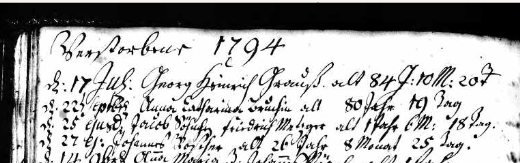
“Verstobenen 1794… 22 Sept: Anna Catharina Bruchin, alt 80 Jahr. 19 tag.” (New Hanover Lutheran Church Book)
This person is clearly the mother of Conrad, David, and Maria Dorothea. In one of the records of her taking communion, she seems to be described as a widow. Indeed, there is no sign of her husband in any record, secular or otherwise, during this time period. However, if we piece together information from a few other sources, we can identify this Anna Catharina and her husband, who must have been the father of Conrad, David, and Anna Dorothea. This person’s name was not Jacob.
To be clear (and to be fair to those who have tried), if one were trying to work backward in time from Conrad and his siblings, it would be extremely unlikely that one would discover the identity of Anna Catharina. I was only able to do so because I was working the other way: I first found Anna Catharina and her husband and then worked forward in time trying to determine if they had any descendants. I did not expect that their descendants included Conrad, the progenitor of the other Prugh family.
The immigrant ancestor of my Prugh family was Johann Matthias Bruch who originally came from Leistadt. In 1722, the village compiled records of who owned what land, a Morgenbuch. Matthias Bruch was listed among the heirs of his father, Matthes Bruch, as I expected. However, there was also a hitherto unknown younger brother named David. This David was never mentioned in the Leistadt Church Book. The only other reference to him was when he was confirmed at Freinsheim Reformed, but his Leistadt origins are never mentioned. The Leistadt Morgenbuch also lists what land children inherited from their parents. In 1748, when the village Schultheiss Johann Wilhelm Freiermuth died, the Morgenbuch recorded the property inherited by his daughter Anna Catharina. This record indicates that she was the wife of David Bruch. It also says that they were in Pennsylvania.
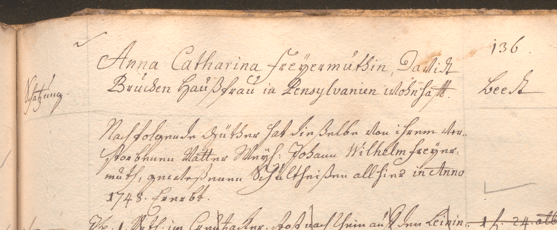
“Anna Catharina Freyermuthin, Davidt Bruchen hausfrau in Pennsylvania wohnhaft…nachfolgende Wetter hab diesalben von ihre verstorbhenn Vatter Weyl. Johann Wilhelm Freyermuth, Schultheissen…” (Anna Catharina Freyermuth, David Bruch’s wife, living in Pennsylvania, inherited the following property from her late father, Johann Wilhelm Freiermuth, the former Schultheiss, in 1748 [the year he died]). (Leistadt Morgenbuch)
The David Bruch in Leistadt is thus the David Bruch who arrived in Philadelphia in 1737 aboard the ship Virtuous Grace. His age on the ship’s list matches what we know about David of Leistadt’s age. The women aboard the ship are not listed, but clearly his wife accompanied him. So we know that David and Anna Catharina left Leistadt and settled in Pennsylvania. We also know Anna Catharina Freiermuth’s birthday from the Leistadt Church Book: 1 September 1714.
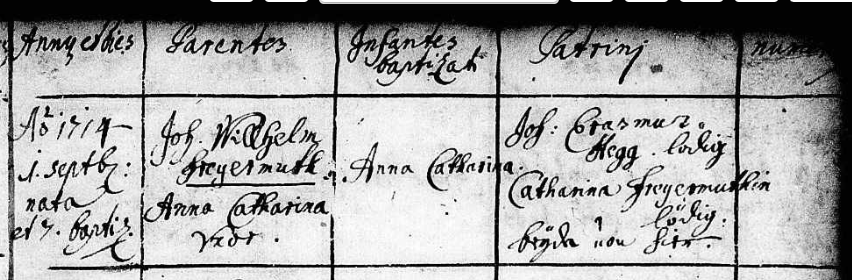
(Leistadt Church Book)
So, we have Anna Catharina Bruch buried in New Hanover Township in 1794 who was born on the same day as Anna Catharina Freiermuth, the wife of David Bruch who immigrated to Pennsylvania in 1737. We can only conclude that the parents of Conrad, David, and Maria Dorothea were David Bruch and Anna Catharina Freiermuth of Leistadt.
The matching birthdate is very strong evidence of this connection. But there is circumstantial evidence as well. The obvious repetition of the name David is suggestive, but admittedly not conclusive on its own. Conrad Bruch was a shoemaker, which was a Freiermuth family trade. Consider also the split confessional nature of the family: David Bruch in Leistadt was confirmed in the Reformed Church and the Freiermuth family was Lutheran. Two Bruch women born in the 1750s, who must also be younger daughters of David and Anna Catharina, were confirmed at Falkner Swamp Reformed in the 1760s. The younger David also had his children baptized and confirmed at Falkner Swamp. Anna Catharina, in her widowhood, communed with the Lutherans. Conrad seems to have chosen his mother’s Lutheranism.
The identification of Conrad’s father as David Bruch of Leistadt contradicts the traditional family stories. According to these stories, Conrad’s father arrived at Trappe in the 1720s, not in 1737. In the versions of the story that name Conrad’s father, his father was named Jacob, not David. Conrad was also the only child, born in the 1740s (what Jacob was doing in the meantime is not specified). These stories do not cite any evidence for how they know the name of Conrad’s father. The details of his life that some of these stories relate are obviously fanciful: he was from Prussia, or he was even related to Prussian royalty, or he was a Protestant refugee from Austria, to name a few variants. Some stories say that he was a Redemptioner who was able to raise funds to end his indenture early as well as redeem either his wife or his betrothed.
In short, no one ever actually knew the name of Conrad’s father. The legend took on a life of its own. Where the name Jacob came from is anyone’s guess.
There are possibly some elements of truth in these stories, however. Conrad’s father probably did settle in or near Trappe. The area around Trappe is where we first encounter the family in the historical record. Conrad’s father probably was a Redemptioner to cover the cost of the voyage. For all we know he might have raised the funds to end his indenture early, as the stories claim. But his name was not Jacob, and he arrived in 1737, not in the 1720s.
So, with this new evidence, we are left with two possibilities: either Conrad was the son of a man named Jacob who left absolutely no trace in the record, or he was the son of David and Anna Catharina Freiermuth as all the evidence that exists indicates. One possibility contradicts the evidence, the other possibility contradicts the legends.
Since the late 19th Century, the two Prugh families have wondered if we were related to each other. There were theories as to how we could be related, but there was no evidence. I was skeptical of any close connection. If we were related, I thought, our last common ancestor must be in Germany and probably lived so long ago that it would be hard to document the connection. It seems that we are related, and more closely than I thought. The two families are descended from two brothers, sons of Matthes Bruch of Leistadt. Matthias Bruch came to Pennsylvania in 1736 and settled in Northampton County. David Bruch came in 1737 and settled in what is now Montgomery County.
It is not clear if Conrad or David is the eldest surviving son of David and Anna Catharina. Conrad, as is well-known, moved to Frederick County, Maryland and eventually acquired a piece of the tract known as “Brother’s Inheritance.” The younger David moved to Lebanon, Pennsylvania, around the turn of the 19th Century. His family seems to have been known as “Brugh” or “Brough” (they are not related to the York County family also known as “Brough” who were descended from Hermanus Bruch who, genetics confirm, is not related to the Prugh families).
More research must be done to flesh out some details, but it does seem that, after all, the two Prugh families are really two branches of the same Leistadt Bruch family. Some interesting new questions arise:
- Is there a reason that the “Prugh” variant only appears among descendants of the Leistadt family? Does it have something to do with the local dialect?
- Did David and Matthias ever meet in Pennsylvania? David certainly knew Matthias had immigrated, but did he know where he settled? Did Matthias know David intended to leave Leistadt?
- Did Matthias and David intend to leave together in 1736? Why did David wait a year? Did it have something to do with his sudden marriage around that time?
- What became of the family of the younger David, who settled in Lebanon? Unlike the first questions, this one can likely be answered.
More to come!
 Bruch Family History